KB to MB converter
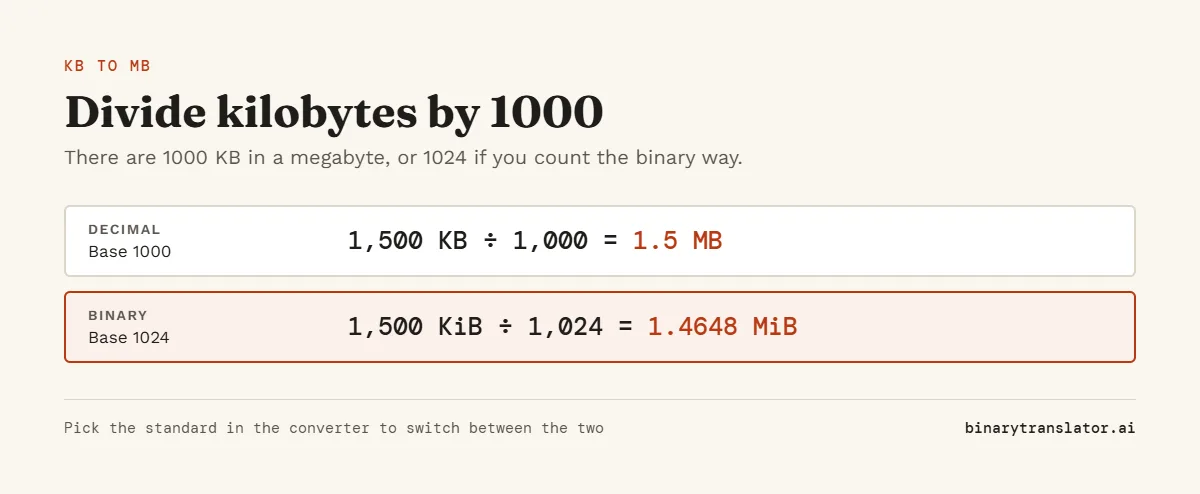
Convert kilobytes to megabytes. 1 MB is 1000 KB, so divide by 1000 for decimal megabytes, or by 1024 for the binary megabytes Windows shows. The converter gives both answers at once.
Show the working
Same size in every unit
Conversion table


Runs in your browser. Nothing you type is uploaded.
How many kilobytes in a megabyte?
There are 1000 kilobytes in a megabyte in the decimal system used by drive makers, websites and macOS. In the binary system used by Windows and RAM there are 1024. That gives two formulas:
MB = KB ÷ 1000 (decimal) or MB = KB ÷ 1024 (binary)
The binary units are sometimes written KiB and MiB to keep them apart, using the IEC binary prefixes. When a site or form gives a limit in MB, it almost always means the decimal one.
KB vs MB: which is bigger?
MB is bigger. A megabyte is a thousand kilobytes, so KB is the smaller unit and a file of 500 KB is half a megabyte. The order from small to large is byte, KB, MB, GB, TB. If you see two sizes in different units, convert them to the same unit before you compare: 900 KB is smaller than 1.2 MB, because 1.2 MB is 1200 KB.
KB to MB examples
- 1000 KB ÷ 1000 = 1 MB, or 0.977 MB in binary.
- 1500 KB ÷ 1000 = 1.5 MB, or 1.465 MB in binary.
- 2000 KB ÷ 1000 = 2 MB, or 1.953 MB in binary.
- 2048 KB ÷ 1024 = exactly 2 MB in binary, or 2.048 MB in decimal.
KB to MB conversion table
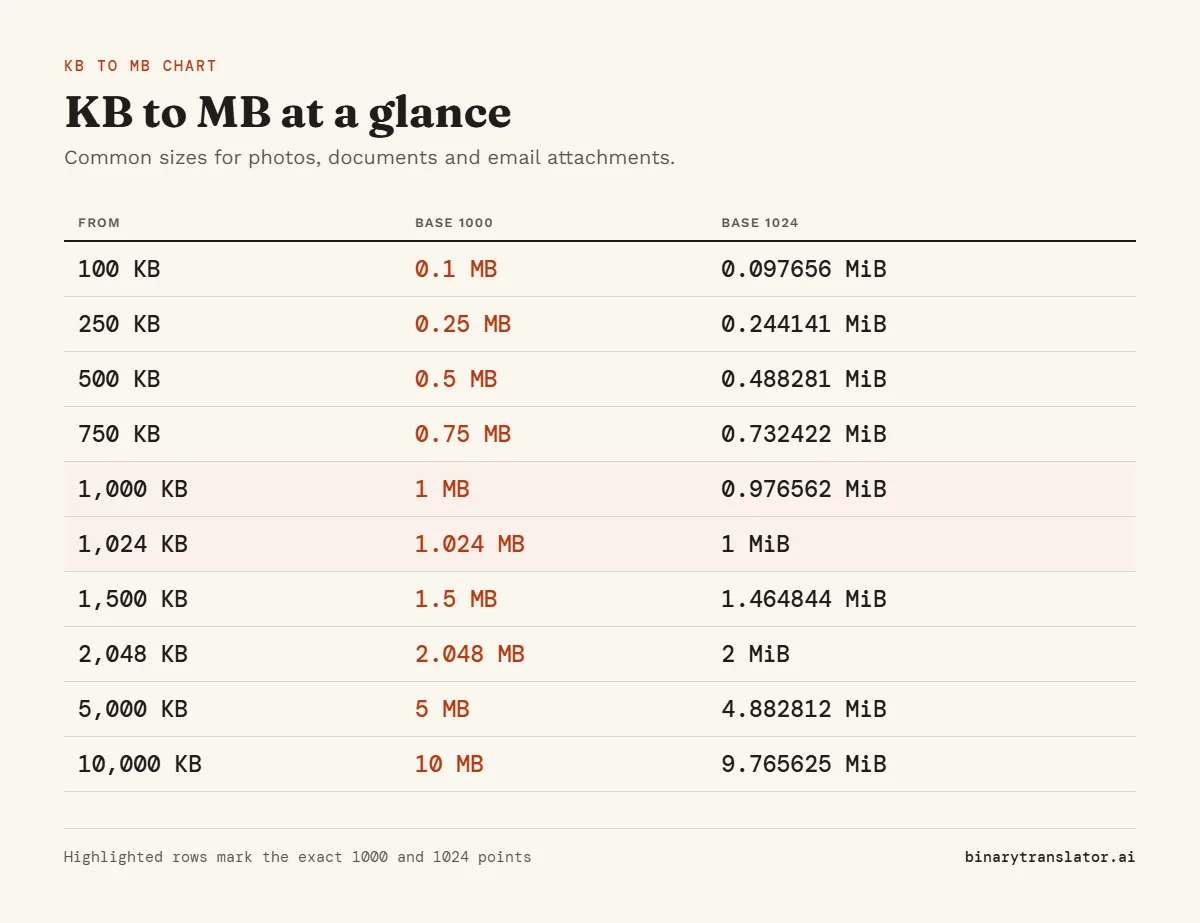
| Kilobytes | Megabytes (1000) | Megabytes (1024) |
|---|---|---|
| 100 KB | 0.1 MB | 0.0977 MB |
| 250 KB | 0.25 MB | 0.2441 MB |
| 500 KB | 0.5 MB | 0.4883 MB |
| 1000 KB | 1 MB | 0.9766 MB |
| 1024 KB | 1.024 MB | 1 MB |
| 1500 KB | 1.5 MB | 1.4648 MB |
| 2000 KB | 2 MB | 1.9531 MB |
| 5000 KB | 5 MB | 4.8828 MB |
| 10,000 KB | 10 MB | 9.7656 MB |
| 25,000 KB | 25 MB | 24.4141 MB |
MB to KB
Going the other way, multiply by 1000 (or 1024 for binary). Press the arrow button in the converter to swap the units, or open the MB to KB converter for more examples and an upload limit check. A few sizes people look up often:
| Megabytes | Kilobytes (1000) | Kilobytes (1024) |
|---|---|---|
| 1 MB | 1000 KB | 1024 KB |
| 2 MB | 2000 KB | 2048 KB |
| 5 MB | 5000 KB | 5120 KB |
| 10 MB | 10,000 KB | 10,240 KB |
| 25 MB | 25,000 KB | 25,600 KB |
| 100 MB | 100,000 KB | 102,400 KB |
Which answer should you use?
Use 1000 when a website or form sets a limit in MB, such as an upload cap, and when you work on a Mac. Use 1024 when you compare with Windows File Explorer, which divides by 1024 but still writes "KB" and "MB". The two answers differ by about 2.4%, which matters near a limit: a file Windows lists as 24,500 KB is 25.09 decimal MB, just over a 25 MB cap.
Old floppy disks mixed both systems. A "1.44 MB" disk held 1440 × 1024 bytes, so its MB meant 1000 × 1024 bytes and matched neither standard.
How big is a kilobyte in practice?
One plain English letter takes one byte, so a page of plain text with about 2000 characters is roughly 2 KB. Office documents carry formatting and usually land between 20 KB and a few hundred KB. A compressed web photo is often 100 to 500 KB, while a full-size phone photo is commonly 2 to 5 MB. For anything larger, KB to GB skips the middle step, and the byte converter handles any other pair.
Frequently asked questions
How many KB are in 1 MB?
1000 KB in the decimal system and 1024 KB in the binary system.
Is KB smaller than MB?
Yes. One megabyte is 1000 kilobytes, so a kilobyte is a thousandth of a megabyte.
How many KB is 5 MB?
5000 KB in decimal units, or 5120 KB in binary units.
How many KB is 10 MB?
10,000 KB in decimal units, or 10,240 KB in binary units.
How do I convert KB to MB in my head?
Move the decimal point three places to the left. 4500 KB becomes 4.5 MB. That is the decimal answer; the binary one is about 2.4% smaller.
What is the difference between KB and Kb?
KB is kilobytes and Kb is kilobits. One kilobyte is 8 kilobits.