Binary alphabet
Every letter has a binary code. Capital A is 01000001 and lowercase a is 01100001. Type a word or your name to see each letter in binary, or browse the full binary alphabet chart for uppercase, lowercase, digits and symbols.


Runs in your browser. Nothing you type is uploaded.
How to use the binary alphabet
- Type a word or name in the box. Each letter shows up as a tile with its 8 bits, and the whole word appears as one line you can copy.
- Use Show to switch the chart between letters, uppercase only, lowercase only, digits, punctuation or all printable characters.
- Set Bits to 7-bit if your teacher or puzzle writes ASCII without the leading 0. The chart then drops it.
- Click a row to copy it, or download the chart as CSV or print it.
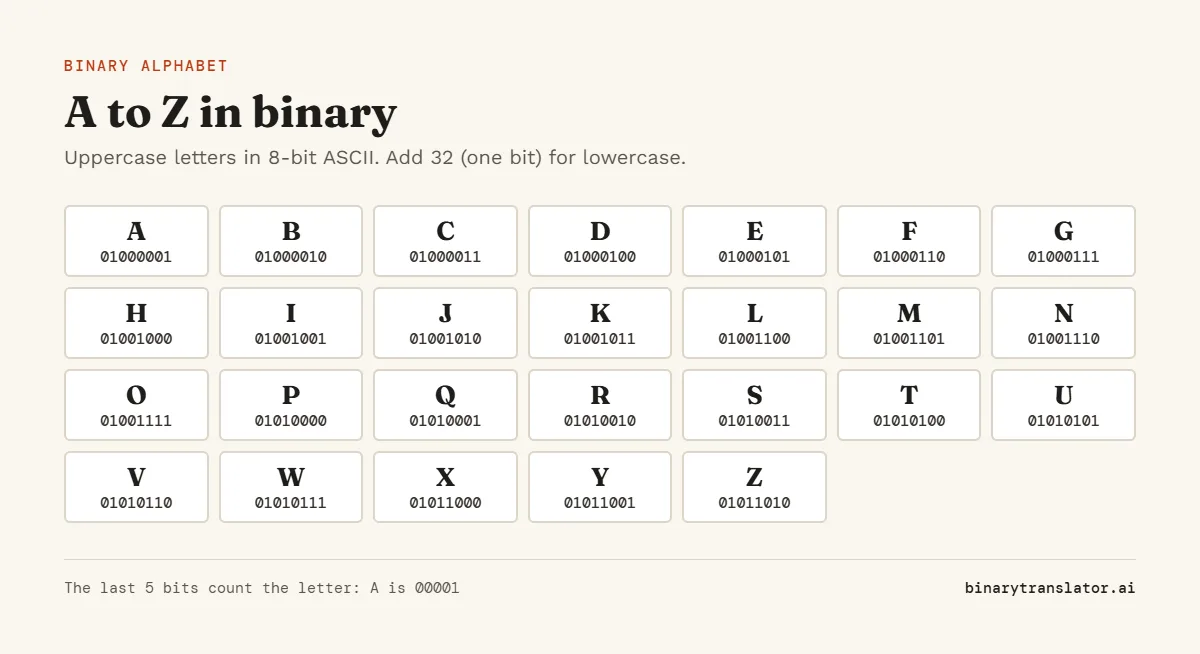
Uppercase letters in binary
| Letter | Binary | Letter | Binary |
|---|---|---|---|
| A | 01000001 | N | 01001110 |
| B | 01000010 | O | 01001111 |
| C | 01000011 | P | 01010000 |
| D | 01000100 | Q | 01010001 |
| E | 01000101 | R | 01010010 |
| F | 01000110 | S | 01010011 |
| G | 01000111 | T | 01010100 |
| H | 01001000 | U | 01010101 |
| I | 01001001 | V | 01010110 |
| J | 01001010 | W | 01010111 |
| K | 01001011 | X | 01011000 |
| L | 01001100 | Y | 01011001 |
| M | 01001101 | Z | 01011010 |
Lowercase letters in binary
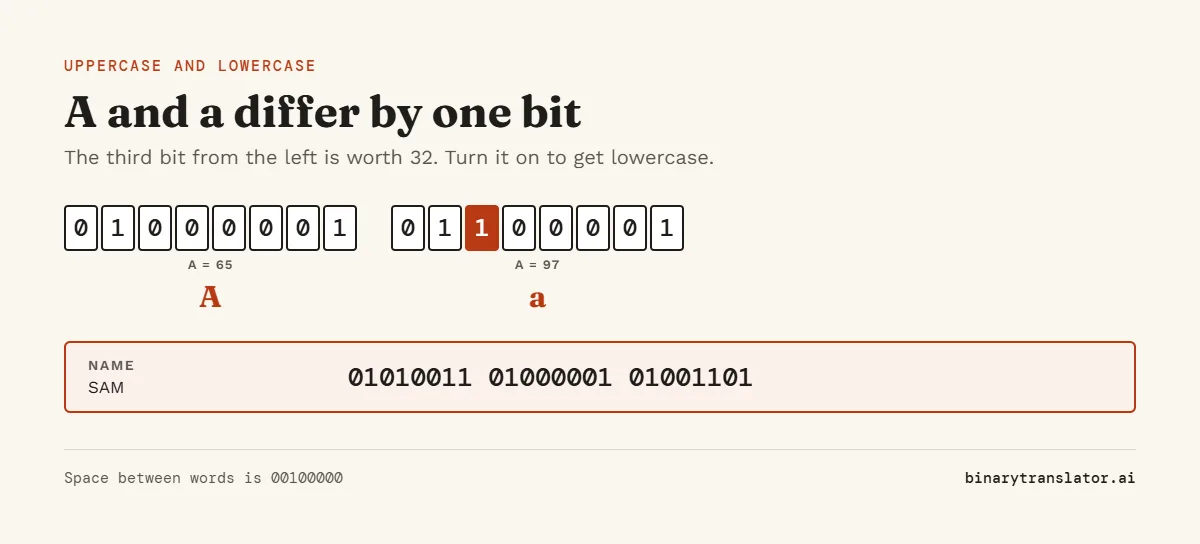
Lowercase letters are the same as uppercase with one extra bit turned on, the third from the left, worth 32. So A is 01000001 and a is 01100001. Every lowercase code starts with 011 and every uppercase code starts with 010.
| Letter | Binary | Letter | Binary |
|---|---|---|---|
| a | 01100001 | n | 01101110 |
| b | 01100010 | o | 01101111 |
| c | 01100011 | p | 01110000 |
| d | 01100100 | q | 01110001 |
| e | 01100101 | r | 01110010 |
| f | 01100110 | s | 01110011 |
| g | 01100111 | t | 01110100 |
| h | 01101000 | u | 01110101 |
| i | 01101001 | v | 01110110 |
| j | 01101010 | w | 01110111 |
| k | 01101011 | x | 01111000 |
| l | 01101100 | y | 01111001 |
| m | 01101101 | z | 01111010 |
How to read a letter from its binary
Look at the last 5 bits. They count the position in the alphabet, the same A = 1, B = 2 numbering the letters to numbers tool uses: 00001 is 1 (A), 01000 is 8 (H), 11010 is 26 (Z). The first 3 bits only tell you the case. That makes the binary alphabet easy to decode by hand once you know the place values 16, 8, 4, 2 and 1. For a whole message, paste it into the binary translator.
Write your name in binary
Write the code for each letter, one after another, with a space between letters. The name SAM is S 01010011, A 01000001, M 01001101, so 01010011 01000001 01001101. A space between words is its own code, 00100000. Type your name in the box at the top to get it at once, or use text to binary for longer text.
Where the codes come from
These are ASCII codes, the standard from 1963 that gives each letter, digit and symbol a number from 0 to 127. NIST still hosts the 1977 revision, ANSI X3.4-1977, with the full code table. A is 65, so its binary is 1000001, padded to 8 bits as 01000001. The ASCII table lists all 128 codes in decimal, hex and binary. To turn a string of these codes back into characters, use binary to ASCII.
Frequently asked questions
What is A in binary?
Capital A is 01000001. Lowercase a is 01100001.
What is the binary code for space?
00100000, which is 32 in decimal.
Why do the letters have 8 bits?
ASCII needs 7 bits, but computers store text in 8-bit bytes, so a 0 is added at the front.
Is there binary for letters with accents?
Yes, but they take more than one byte in UTF-8. For example, é is 11000011 10101001. Use text to binary for those.