Binary numbers chart
Look up any number in binary. Type a number to see its bits under their place values, or scroll the chart of binary numbers from 0 up to 1023 with hex and octal beside each one. To start from hex instead, use the hexadecimal table. You can download the chart as CSV or print it.


Runs in your browser. Nothing you type is uploaded.
How to use the binary chart
- Type a number in the box at the top. It appears in binary with each bit under its place value, along with the sum that makes it.
- Choose how far the chart goes with Show, from 0 to 15 up to 0 to 1023.
- Set Bits to pad every row to 4, 8 or 16 bits, or leave it on Auto.
- Type in Jump to and the chart scrolls to that row. Click a row to copy it.
How binary numbers work
Our usual numbers are base 10: each place is worth 10 times the one to its right, so 345 is 3 hundreds, 4 tens and 5 ones. Binary is base 2. It only has the digits 0 and 1, and each place is worth 2 times the one to its right: 1, 2, 4, 8, 16, 32, 64, 128 and so on. A 1 means that place counts and a 0 means it does not.
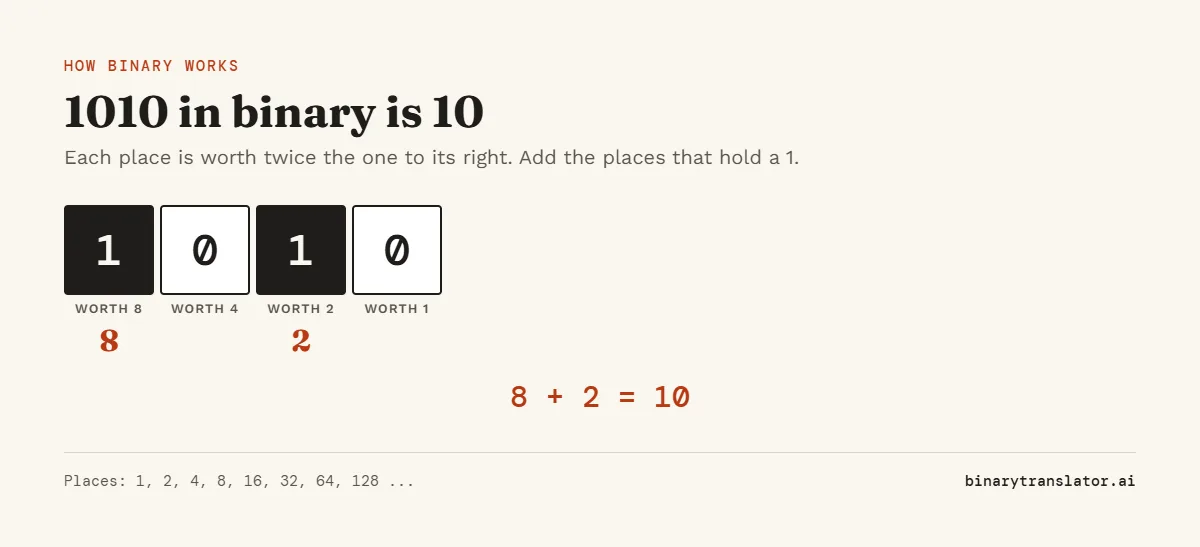
Take 1010. Reading the places from the right as 1, 2, 4 and 8, the 1s sit under 8 and 2. So 1010 is 8 + 2 = 10, the same sum the binary to decimal converter shows for any number. Going the other way, the decimal to binary converter finds which places need a 1.
Binary numbers 0 to 20
| Decimal | Binary | Decimal | Binary |
|---|---|---|---|
| 0 | 0 | 11 | 1011 |
| 1 | 1 | 12 | 1100 |
| 2 | 10 | 13 | 1101 |
| 3 | 11 | 14 | 1110 |
| 4 | 100 | 15 | 1111 |
| 5 | 101 | 16 | 10000 |
| 6 | 110 | 17 | 10001 |
| 7 | 111 | 18 | 10010 |
| 8 | 1000 | 19 | 10011 |
| 9 | 1001 | 20 | 10100 |
| 10 | 1010 |
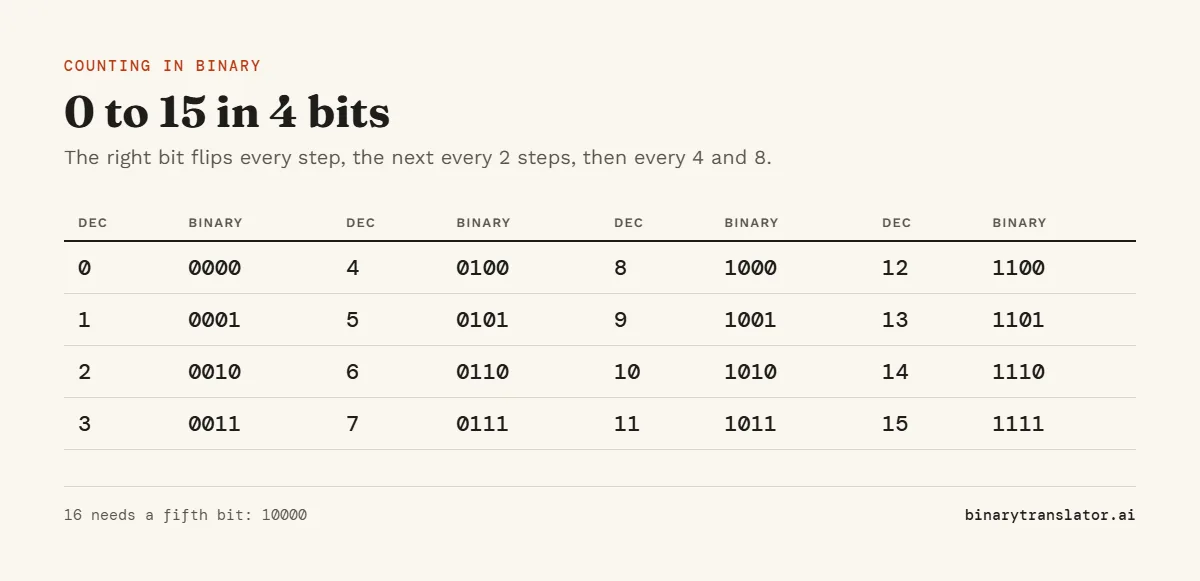
Notice the pattern. The rightmost bit flips every step, the next one every 2 steps, the next every 4 and so on. Each time a column is full of 1s, the next number adds a new column on the left, just as 99 rolls over to 100 in decimal.
Counting in binary
To add 1, change the rightmost 0 to 1 and turn every 1 to its right into 0. So 1011 (11) plus 1 is 1100 (12). Every power of 2 is a 1 followed by zeros: 2 is 10, 4 is 100, 8 is 1000 and 1024 is 10000000000. Every number that is one less is all 1s: 7 is 111, 15 is 1111 and 255 is 11111111.
Numbers people often look up
| Decimal | Binary | Bits |
|---|---|---|
| 2 | 10 | 2 |
| 4 | 100 | 3 |
| 7 | 111 | 3 |
| 9 | 1001 | 4 |
| 10 | 1010 | 4 |
| 11 | 1011 | 4 |
| 16 | 10000 | 5 |
| 32 | 100000 | 6 |
| 64 | 1000000 | 7 |
| 100 | 1100100 | 7 |
| 127 | 1111111 | 7 |
| 255 | 11111111 | 8 |
| 1000 | 1111101000 | 10 |
Why computers use binary
A circuit only has to tell two states apart: voltage on or off, a switch open or closed. That is far more reliable than telling ten levels apart. One binary digit is a bit, 8 bits are a byte (see Stanford's CS101 notes on bits and bytes), and a byte can hold 256 different values, from 0 to 255, or from -128 to 127 when the top bit marks a negative number in two's complement. Text, pictures and sound are all stored as long runs of these bits. Each letter, for example, is one byte, as the binary alphabet shows for A to Z.
Frequently asked questions
What is 10 in binary?
1010. That is one 8 and one 2.
What is 2 in binary?
10. The 1 sits in the twos place and the 0 in the ones place.
What is 100 in binary?
1100100, which is 64 + 32 + 4.
How do you write negative numbers in binary?
Computers usually use two's complement, where the top bit means negative. In 8 bits, -1 is 11111111.
Is 1 + 1 = 10 in binary?
Yes. 1 + 1 is 2, and 2 in binary is 10.