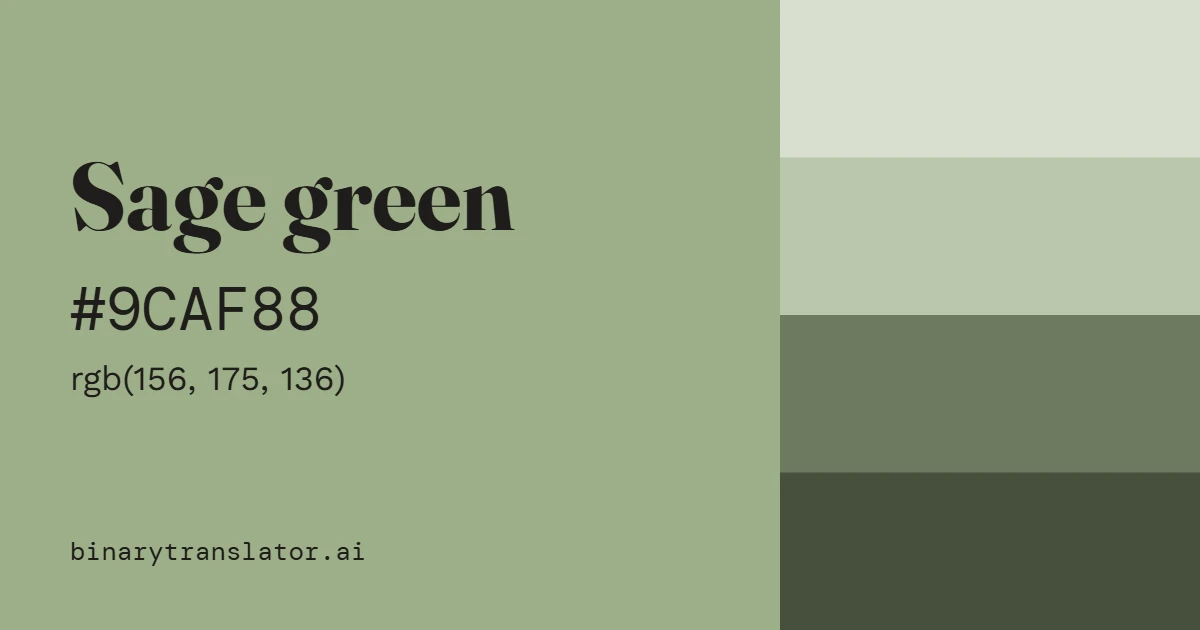
Sage green hex code
#9CAF88
The hex code most often used for sage green is #9CAF88, which is RGB 156, 175, 136. There is no official sage green, and Figma, HTMLColorCodes and Wikipedia each list a different one. All four are compared below.
Click a value to copy it. Move the slider to try a lighter or darker version; the code samples further down follow it.
Runs in your browser. Nothing you type is uploaded.
Sage green color codes
These are all the same sage green, written for different tools. Web and app design use HEX, RGB and HSL, print uses CMYK, and CIE Lab and LCH describe the color the way the eye sees it. Click any code in the tool above to copy it.
| Format | Value |
|---|---|
| HEX | #9CAF88 |
| RGB | rgb(156, 175, 136) |
| HSL | hsl(89, 20%, 61%) |
| HSV | hsv(89, 22%, 69%) |
| CMYK | 11, 0, 22, 31 |
| CIE Lab | 69.1, -13.7, 17.8 |
| LCH | 69.1, 22.5, 127.6 |
| Decimal | 10,268,552 |
| Binary | 10011100 10101111 10001000 |
| CSS color name | None. The closest CSS name is darkseagreen. |
To turn any other code into these values, paste it into the hex to RGB converter.
Which sage green hex code should you use?
Different color sites give different codes for sage green. These are the four you are most likely to run into, where each one comes from and how they differ.
These four are clearly different colors side by side, so pick one and use it everywhere. If you are matching a paint, fabric or brand file, match that sample instead of any of these, since paint companies each have their own sage.
Measured as CIE76 color distance from #9CAF88, #98A869 is 13.4, #8A9A5B is 15.8 and #BCB88A is 11.0. A distance under about 2.3 is hard to see, so all of these are visibly different from the main code. Codes checked on November 5, 2026.
Shades of sage green
No CSS keyword is called sage, but these named colors sit close to it. The ones marked CSS work as color names in any stylesheet.
darkseagreendarkkhakiolivedrabdarkolivegreengrayhoneydewLight sage green and dark sage green
Each step mixes sage green with 10 percent more white (tints) or black (shades), so the hue stays the same. Click a step to copy it.
Colors that go with sage green
Sage is muted, so it works best next to warm browns, cream and one stronger accent. Bright, fully saturated colors like pure red or neon pink make it look dull.
Matches from the color wheel
These come from rotating the hue of #9CAF88 (89 degrees) around the color wheel while keeping its saturation and lightness. They fit together in theory, but check them in your design: a wheel match is a starting point, not a rule.
Sage green color palettes
Three palettes built around sage green, each with a light color for backgrounds and a dark one for text. Click a palette to copy all five codes.
How to make sage green
On a screen
Sage is a green with a lot of red and blue mixed in, which grays it out. On #9CAF88, green (175) is only 19 above red (156), and blue (136) is not far behind. That small gap between the channels is why its saturation is about 20 percent. Spread the channels apart and it turns into a brighter leaf green.
With paint
Start with a mid green and add white to lighten it. Then mute it with a very small amount of its opposite color, red, or a touch of gray. A drop of yellow ochre makes it warmer.
Is text readable on sage green?
WCAG asks for a contrast ratio of at least 4.5 to 1 for normal text and 3 to 1 for large text, which means 24px, or 19px bold. Black text on #9CAF88 is the readable choice.
| Pairing | Contrast | Normal text | Large text |
|---|---|---|---|
| White text on sage green | 2.36:1 | Fails | Fails |
| Black text on sage green | 8.90:1 | Passes | Passes |
How sage green looks with color blindness
With red-green color blindness sage turns tan, around #B0A88A, so sage and beige or khaki can look alike. These are approximate simulations using the Machado matrices for full color blindness. Color blindness affects about 1 in 12 men and 1 in 200 women, mostly the red-green types, so do not use sage green as the only signal for something like an error or a selected state.
Sage green in binary
A hex code is three bytes, one each for red, green and blue. Each pair of hex digits is one byte, and each byte is 8 bits. This is how #9CAF88 is stored:
| Channel | Hex | Decimal | Binary | Bits that are on |
|---|---|---|---|---|
| Red | 9C | 156 | 10011100 | 128 + 16 + 8 + 4 |
| Green | AF | 175 | 10101111 | 128 + 32 + 8 + 4 + 2 + 1 |
| Blue | 88 | 136 | 10001000 | 128 + 8 |
Joined together that is 100111001010111110001000, a 24-bit number equal to 10,268,552 in decimal. The hex to binary converter does the same for any hex value.
Sage green in CSS and code
Copy the version for your stack. The tool above updates these if you change the lightness.
/* CSS */
:root { --sage-green: #9CAF88; }
.button { background: var(--sage-green); color: #1F1D1A; }

<!-- Tailwind -->
<button class="bg-[#9CAF88] text-[#1F1D1A]">Button</button>

// SwiftUI
Color(red: 0.612, green: 0.686, blue: 0.533)

<!-- Android colors.xml -->
<color name="sage_green">#9CAF88</color>

# Python
sage_green = (156, 175, 136)
Sage green color meaning
Sage green suggests nature, calm and balance, which is why it shows up in kitchens, bedrooms, wellness brands and weddings. Because it is muted, it feels quieter and more grown-up than a bright green.
Where the name comes from
The name comes from the garden herb sage, Salvia officinalis, whose leaves are a dusty gray-green. Its low saturation is why it reads as calm rather than bright, and why it sits well with wood, linen, cream and terracotta.
Frequently asked questions
What is the hex code for sage green?
The code used most often is #9CAF88, RGB 156, 175, 136. Figma lists #98A869 and HTMLColorCodes lists #8A9A5B, so if you are matching an existing design, check which one it used.
What is the RGB code for sage green?
RGB 156, 175, 136 for #9CAF88.
Is sage green warm or cool?
It sits in between. Its hue is about 89 degrees, on the yellow side of green, which adds a little warmth, while its low saturation keeps it quiet.
What colors go with sage green?
Cream, terracotta, muted rose, wood tones and charcoal. Bright, fully saturated colors tend to make it look dull.
What is the hex code for light sage green?
Mixing #9CAF88 with 30 percent white gives #BAC7AC, and 50 percent white gives #CED7C4. Both are in the tints row above.
What is the hex code for dark sage green?
Mixing #9CAF88 with 30 percent black gives #6D7A5F. The shades row above has more steps.