Binary to ASCII converter
Paste binary and read it as ASCII text: 01001000 01101001 is Hi. Groups of 8 bits work with or without spaces, and "Show each character" lists the decimal code and letter for every byte.
Show each character


Runs in your browser. Nothing you type is uploaded.
How to use the converter
- Paste binary in the left box. Spaces between bytes are optional, and a
0bprefix is ignored. - Read the ASCII text on the right. Each group of 8 bits becomes one character.
- If accented letters or symbols look wrong, change the Encoding. UTF-8 is the default and also covers plain ASCII.
- Copy, download or share the text. The ASCII to binary tab above the tool goes the other way.
How to convert binary to ASCII
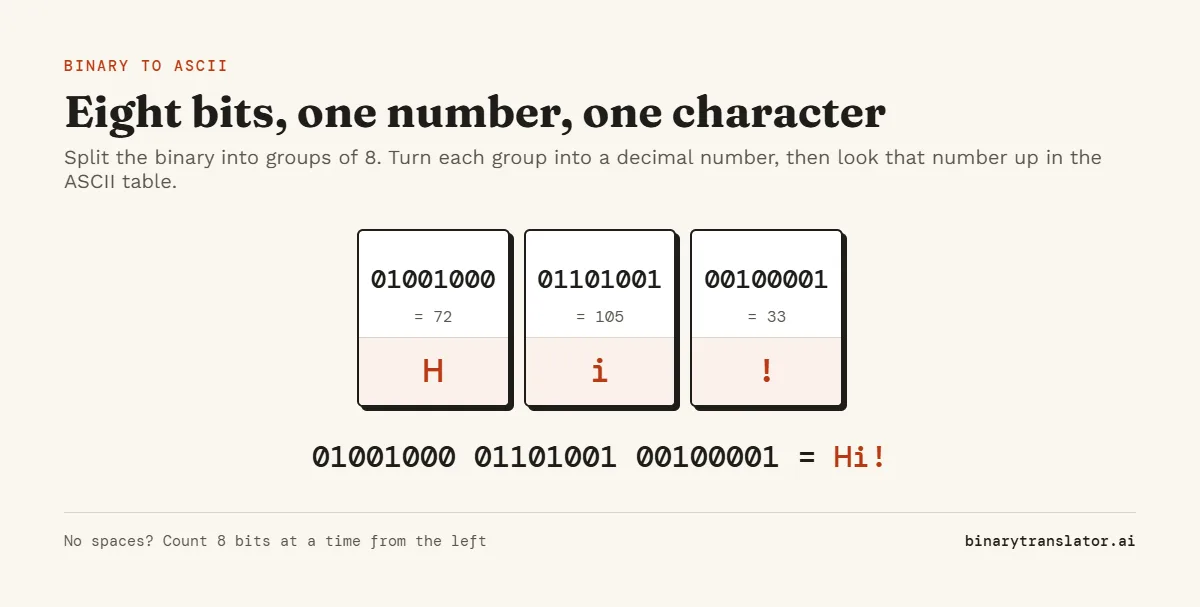
ASCII gives every character a number from 0 to 127, and each number fits in one byte of 8 bits. To decode binary, split it into groups of 8, turn each group into a decimal number, then look the number up.
Reading one byte
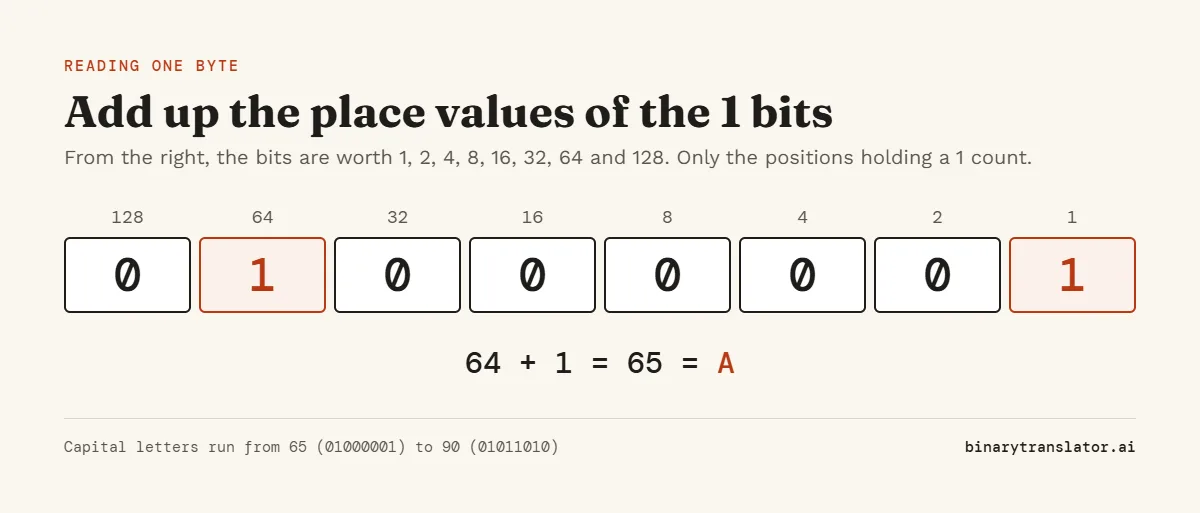
From the right, the bits are worth 1, 2, 4, 8, 16, 32, 64 and 128. Add the values where the bit is 1. 01000001 is 64 + 1 = 65, which is A. 01100001 is 64 + 32 + 1 = 97, which is a. The binary to decimal converter shows this sum for any number.
Binary to ASCII table
| Binary | Decimal | Character |
|---|---|---|
| 00100000 | 32 | space |
| 00100001 | 33 | ! |
| 00101110 | 46 | . |
| 00110000 | 48 | 0 |
| 00111001 | 57 | 9 |
| 00111111 | 63 | ? |
| 01000001 | 65 | A |
| 01000010 | 66 | B |
| 01011010 | 90 | Z |
| 01100001 | 97 | a |
| 01111010 | 122 | z |
| 00001010 | 10 | new line |
The full list of 128 codes, with hex and octal columns, is in the ASCII table.
Worked examples
| Binary | ASCII text |
|---|---|
| 01001000 01101001 | Hi |
| 01001111 01001011 | OK |
| 01011001 01100101 01110011 | Yes |
| 01000001 01000010 01000011 | ABC |
| 00110001 00110010 00110011 | 123 |
| 01001000 01100101 01101100 01101100 01101111 | Hello |
The digits in 00110001 00110010 00110011 decode to the text 123, not the number. Every digit character starts with 0011, and its last four bits are the digit itself.
7-bit and 8-bit binary
ASCII was designed as a 7-bit code, so the highest value is 127, or 1111111. Files and messages store it as 8-bit bytes with a 0 in front, the layout RFC 20 proposed for network use in 1969. If your binary comes in 7-bit groups such as 1001000 1101001, keep the spaces: the converter pads each group to 8 bits and still reads Hi. A long run of 7-bit codes with no spaces cannot be split reliably, so the tool expects a multiple of 8 bits in that case.
When the result looks wrong
- "Text needs a multiple of 8" means a bit is missing or extra somewhere. One lost bit shifts every character after it.
- A ? or odd symbol usually means a byte above 127, which is outside ASCII. Try UTF-8 or Windows-1252 under Encoding.
- Garbled letters such as é mean the bytes are UTF-8 but were read with a single-byte encoding. Switch Encoding back to UTF-8.
- One long binary number, such as a value from a register, is not text at all. Use binary to decimal instead.
For any binary that turns out to be text in another language or with emoji, the binary translator handles UTF-8 and around 40 other encodings in the same way.
Binary to ASCII in code
Python: ''.join(chr(int(b, 2)) for b in "01001000 01101001".split()) returns 'Hi'. JavaScript: "01001000 01101001".split(" ").map(b => String.fromCharCode(parseInt(b, 2))).join("") returns "Hi". Both read each group with base 2 and turn the number into a character, the job Python's chr() does.
Frequently asked questions
What is 01000001 in ASCII?
A. The bits 01000001 add up to 65, and 65 is capital A.
What is 01101111 in ASCII?
The small letter o. 64 + 32 + 8 + 4 + 2 + 1 = 111, which is the code for o.
How many bits is one ASCII character?
Seven bits are enough for every ASCII code, but each character is normally stored as one 8-bit byte with a leading 0.
Is ASCII still used today?
Yes. The first 128 characters of UTF-8, the encoding used by almost every web page, are exactly the ASCII codes, so any ASCII file is also valid UTF-8.
What is the difference between binary to ASCII and binary to text?
For English text there is none. Binary to text can also cover accented letters, other alphabets and emoji, which take more than one byte in UTF-8.
Is my binary sent anywhere?
No. Everything is decoded in your browser.