Hexadecimal table
A hexadecimal table with decimal, binary and octal for every value from 00 to FF, or up to FFF. Type a hex or decimal value to see its bits and jump to its row. Download the table as CSV or print it.


Runs in your browser. Nothing you type is uploaded.
How to use the hex table
- Type a hex value like
FFor0x1A, or a plain decimal number, in the box at the top. - See its binary with place values, plus hex and decimal side by side. The matching row lights up in the table.
- Pick the range in Show: 0 to F, 00 to FF or 000 to FFF.
- Click a row to copy it, or press Download CSV or Print.
A value with only digits, such as 10, is read as decimal. Add 0x in front, as in 0x10, to mean hex.
The 16 hex digits
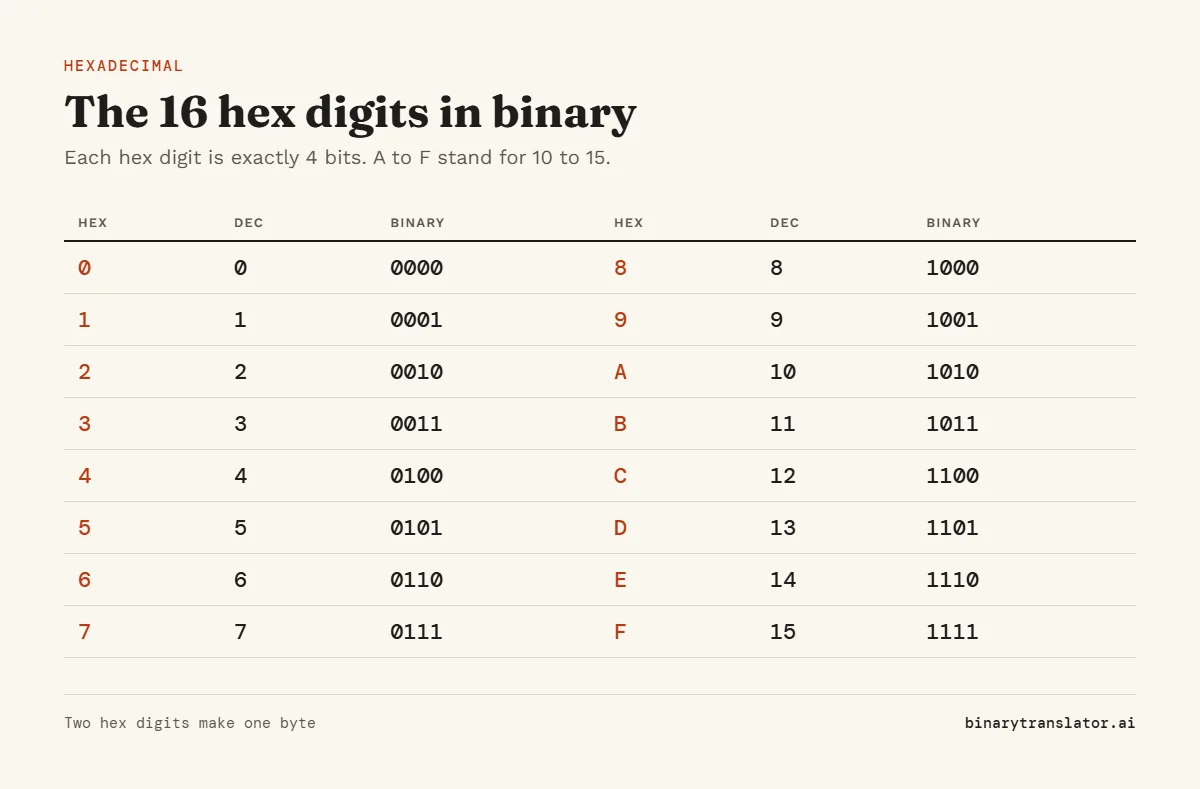
Hexadecimal is base 16. It uses 0 to 9 and then the letters A to F for 10 to 15. Each hex digit stands for exactly 4 bits, which is why programmers use hex as a short way to write binary. The printable hexadecimal worksheet starts from this same idea. Text is often shown in hex too, and the ASCII table lists the hex code for each character.
| Hex | Decimal | Binary | Hex | Decimal | Binary |
|---|---|---|---|---|---|
| 0 | 0 | 0000 | 8 | 8 | 1000 |
| 1 | 1 | 0001 | 9 | 9 | 1001 |
| 2 | 2 | 0010 | A | 10 | 1010 |
| 3 | 3 | 0011 | B | 11 | 1011 |
| 4 | 4 | 0100 | C | 12 | 1100 |
| 5 | 5 | 0101 | D | 13 | 1101 |
| 6 | 6 | 0110 | E | 14 | 1110 |
| 7 | 7 | 0111 | F | 15 | 1111 |
How to read a two-digit hex value
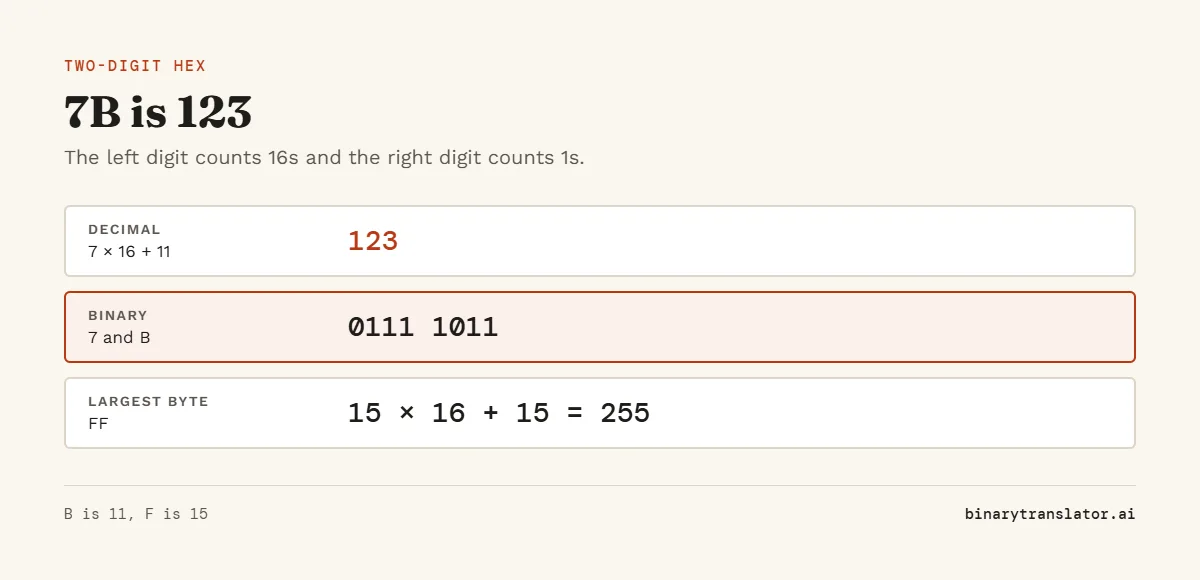
The left digit counts sixteens and the right digit counts ones. So 7B is 7 × 16 + 11 = 123, and the hex to decimal converter shows this step for longer values. In binary you just write the two 4-bit groups side by side: 7 is 0111 and B is 1011, so 7B is 0111 1011. One byte always fits in two hex digits, from 00 to FF, the same 256 values the binary numbers chart lists in base 2.
Hex values worth knowing
| Hex | Decimal | Binary | Where you see it |
|---|---|---|---|
| 0A | 10 | 0000 1010 | Line feed character |
| 20 | 32 | 0010 0000 | Space character |
| 41 | 65 | 0100 0001 | Letter A |
| 7F | 127 | 0111 1111 | Largest 7-bit value, signed byte max |
| 80 | 128 | 1000 0000 | Top bit set |
| FF | 255 | 1111 1111 | Largest byte, full color channel |
| 100 | 256 | 1 0000 0000 | Values in one byte |
| FFFF | 65,535 | 16 ones | Largest 16-bit value |
Converting with the table
To convert hex to binary, replace each digit with its 4 bits from the table above, or paste a longer value into the hex to binary converter. To go from binary to hex, split the bits into groups of 4 from the right and look each group up, which the binary to hex converter does for any length. For decimal, multiply each hex digit by its place value: 1, 16, 256, 4096 and so on, then add. To go the other way, the decimal to hex converter shows the steps for any number.
Frequently asked questions
What is FF in decimal?
255. F is 15, so FF is 15 × 16 + 15.
What is A in hexadecimal?
A is 10 in decimal and 1010 in binary.
Why does hex use letters?
Base 16 needs 16 single digits. After 0 to 9 the letters A to F fill in 10 to 15.
How many bits is one hex digit?
Four. Two hex digits make one 8-bit byte.