
Reviewer
Mehran Mozaffari Kermani
Professor of computer engineering, University of South Florida
About Mehran
Mehran Mozaffari Kermani is a professor at the Bellini College of Artificial Intelligence, Cybersecurity and Computing at the University of South Florida. His research covers computer arithmetic, cryptographic hardware and fault detection in digital circuits, and he worked as an ASIC design engineer at AMD before he joined academia. He earned his PhD in electrical and computer engineering at the University of Western Ontario, was a postdoctoral fellow at Princeton and is a senior member of IEEE. On binarytranslator.ai he reviews the logic gate, binary arithmetic and floating-point tools.
In Mehran's words
In hardware, an adder is just gates wired together. If you understand XOR and AND, you understand how a chip adds two numbers.
Tools Mehran reviewed
Guides
 Binary basics
Flip-flops and latches: SR, D, JK and T explained
How SR latches and D, JK and T flip-flops store a bit, with a simulator, truth tables, timing diagrams, excitation tables and conversions.18 min read Binary basics
What is a checksum? How checksums, parity bits and CRC catch errors
A checksum is a short value calculated from data so you can tell if it changed. See a byte sum, parity bits, the internet checksum, CRC, Hamming codes and SHA-256, each worked through.16 min read Binary basics
Floating point numbers explained: why 0.1 + 0.2 is not 0.3
A floating point number is scientific notation in binary. See why 0.1 + 0.2 is 0.30000000000000004, how precise floats are, float vs double, and how to compare floats and handle money.9 min read Programming
Python bitwise operators and XOR, with examples
Python's bitwise operators &, |, ^, ~, << and >> explained bit by bit. XOR for flipping bits, ciphers and logical XOR, masks and flags, shifts, and & versus and.10 min read Binary basics
Half adder and full adder
Half adder and full adder circuits with truth tables and Boolean equations, a full adder built from two half adders, a 4-bit ripple carry adder you can try, and subtraction with the same circuit.7 min read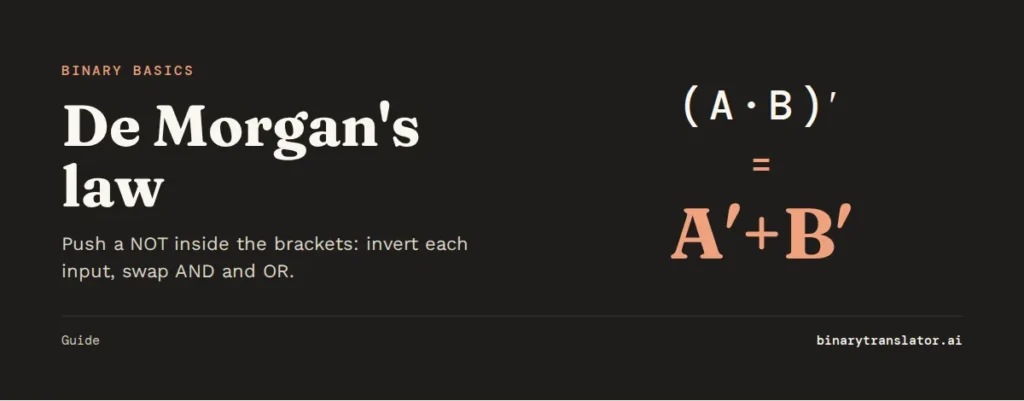 Binary basics
De Morgan's law explained
Both of De Morgan's laws with a truth table proof, a live checker, step-by-step examples, practice problems, and how the laws work in logic gates and in code.8 min read Binary basics
Logic gates explained
The 7 basic logic gates with symbols, Boolean expressions and truth tables, a live tester for every gate, and how NAND gates and half adders turn bits into arithmetic.9 min readQuestions for Mehran
- How does your research connect to this site?
- My research is on computer arithmetic and on detecting faults in digital circuits, including the hardware that runs cryptography. All of it is built from the same logic gates and binary operations the tools here show, at a much larger scale.
- What do you check in the logic gate and arithmetic tools?
- That the truth tables are complete and that carries and borrows land in the right column. A half adder is XOR for the sum and AND for the carry, and the working in the calculator should match what the circuit does bit by bit.
- What should students learn first?
- The gates and their truth tables. Every larger circuit, from an adder to a multiplier, is built from them, and a wrong row in a truth table becomes a wrong answer everywhere that gate is used.