
10guides
About Zachary
Zachary Painter is a technical writer at GitLab, where he writes developer documentation and UI text. He has written API documentation for REST and GraphQL APIs and reference docs for Kubernetes, Docker and command-line tools, earlier as a technical writer at Pomerium and a senior technical content writer at Stream. He holds a BA in English and German studies from the University of North Carolina at Greensboro. On binarytranslator.ai he writes guides and the how-to sections on tool pages.
In Zachary's words
Good how-to steps let you finish the task without guessing. I write each one so you can follow it with the tool open next to you.
Guides
 Programming
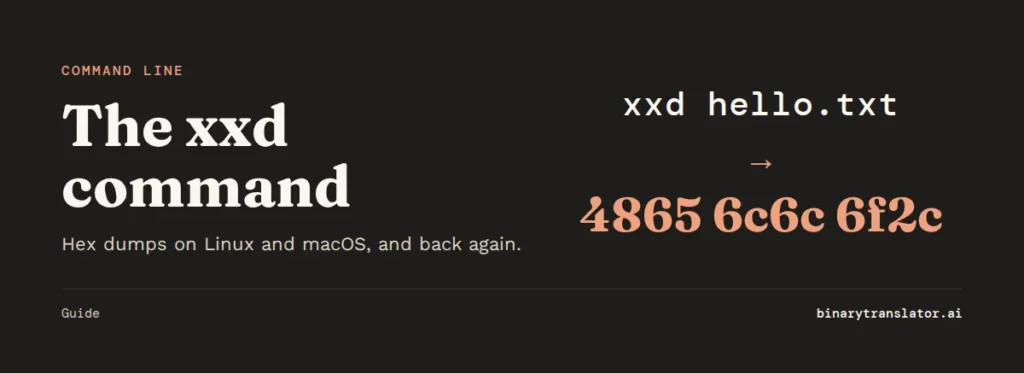
The xxd command: hex dumps on Linux and macOS
Use xxd to read the bytes in any file, get plain hex with -p, turn hex back into binary with -r, patch a byte, print bits, make C arrays and diff binary files.9 min read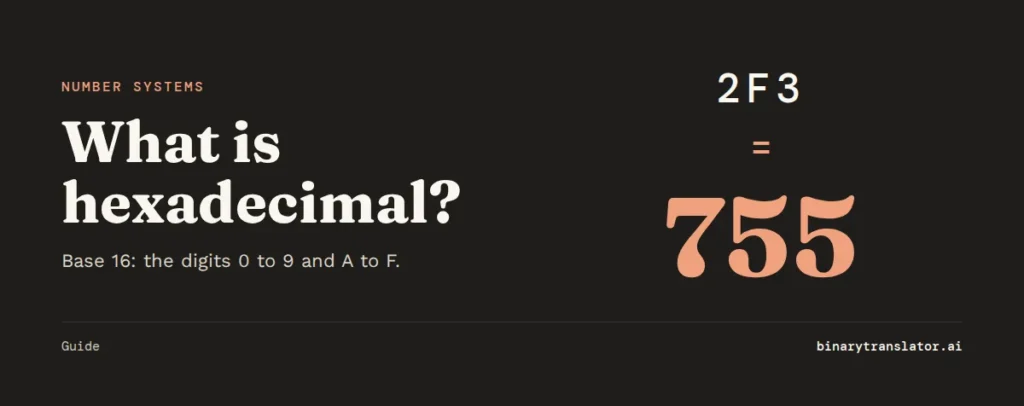 Binary basics
What is hexadecimal? The base 16 number system explained
Hexadecimal is base 16, with digits 0 to 9 and A to F. See how place values work, why programmers use hex for bytes, the values worth knowing and how octal compares.7 min read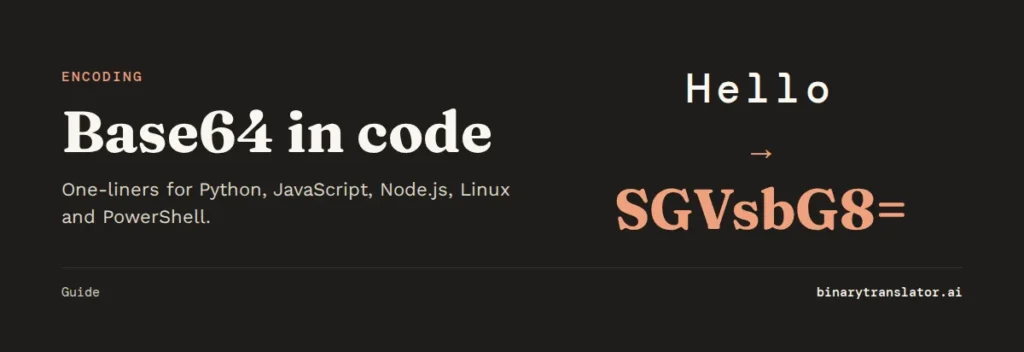 Programming
Base64 encode and decode in Python, JavaScript, Linux and PowerShell
Base64 one-liners for Python, the browser, Node.js, Linux, macOS and PowerShell, with a command builder and fixes for padding errors, echo newlines, line wrapping and UTF-16.13 min read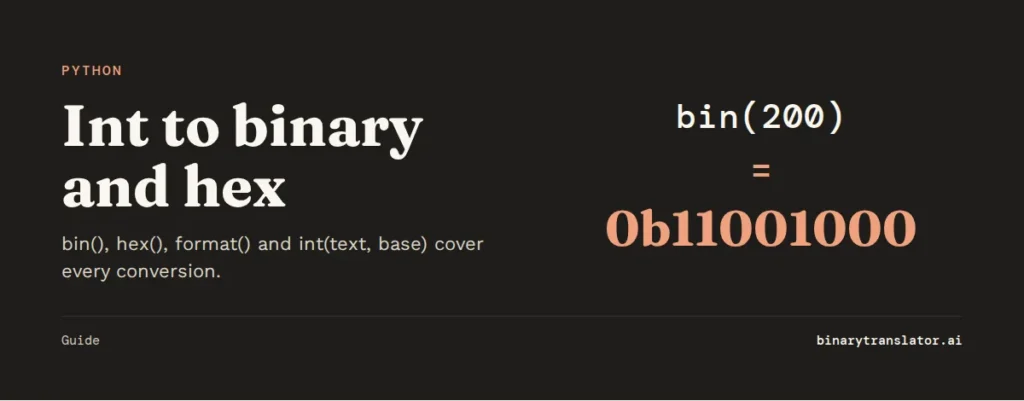 Programming
Convert int to binary and hex in Python, and back
Convert integers to binary, hex and octal strings in Python and back again. Padding, removing the 0b prefix, negative numbers in two's complement, text to binary and a cheat sheet.9 min read Programming
Python bytes to string and string to bytes
Convert bytes to a string with decode() and a string to bytes with encode(). Includes a live encoder, the str(b) bug, UnicodeDecodeError fixes, int.to_bytes() and hex.11 min read Binary basics
Half adder and full adder
Half adder and full adder circuits with truth tables and Boolean equations, a full adder built from two half adders, a 4-bit ripple carry adder you can try, and subtraction with the same circuit.7 min read Binary basics
Big endian vs little endian
What endianness means, how 0x12345678 sits in memory in each order, which processors and file formats use which, network byte order, hex dumps and code to convert.8 min read Binary basics
Boolean algebra explained
Boolean algebra from the start: the three operations, every law in one table, three worked simplifications, truth tables, sum of products, and a calculator that builds the table for you.8 min read Binary basics
Logic gates explained
The 7 basic logic gates with symbols, Boolean expressions and truth tables, a live tester for every gate, and how NAND gates and half adders turn bits into arithmetic.9 min read Binary basics
Powers of 2
The full powers of 2 chart from 2^0 to 2^64, a calculator for any exponent, and why 256, 1,024 and 65,536 keep showing up in bytes, colors and file sizes.6 min readQuestions for Zachary
- What makes a good how-to section?
- One action per step, in the order you'd actually do it, with the result you should see. If a step says 'convert the value' without saying where to click or what appears, it isn't done yet.
- How does writing docs at GitLab shape your guides here?
- In docs work every example has to run, and every term means the same thing on every page. I bring the same habits here: one word for one thing, and examples that work when you paste them in.
- Where do people get stuck with hex?
- Seeing letters in a number. Once you know that A to F stand for 10 to 15, and that one hex digit is four bits, hex reads almost as easily as decimal.