
11guides
About Uma
Uma Victor is a technical writer and software engineer with seven years of engineering work. He writes API documentation, integration guides and tutorials for developer tools, and his articles have run in Smashing Magazine, freeCodeCamp and LogRocket. He runs the code before he writes about it. On binarytranslator.ai he writes the guides on binary, hex and text encoding.
In Uma's words
Binary doesn't mean one thing. 01000001 is 65 as a number and A as text, and a tool can't know which one you meant unless you tell it. Most wrong answers I've seen come from that, not from the math.
Guides
 Binary basics
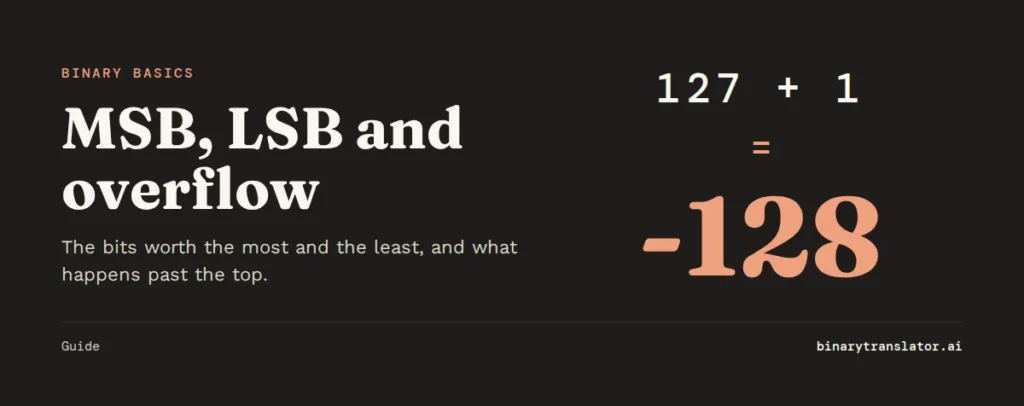
MSB and LSB: most and least significant bits, signed integers and overflow
The MSB is the leftmost, highest-value bit and the LSB the rightmost. See what each tells you, how signed integers use the MSB as a sign bit, and how integer overflow wraps values around.9 min read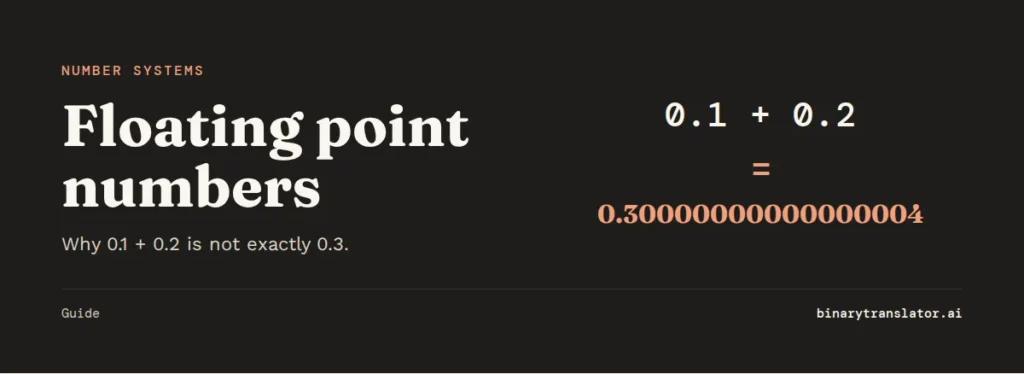 Binary basics
Floating point numbers explained: why 0.1 + 0.2 is not 0.3
A floating point number is scientific notation in binary. See why 0.1 + 0.2 is 0.30000000000000004, how precise floats are, float vs double, and how to compare floats and handle money.9 min read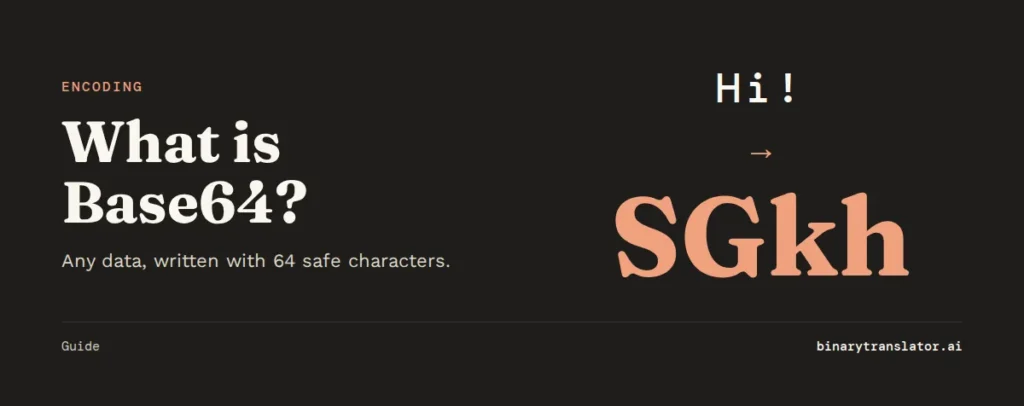 Binary basics
What is Base64? How Base64 encoding works
Base64 writes any data with 64 safe characters. See the bit-by-bit steps, the alphabet, why strings end in = or ==, why the result is a third bigger and where you will meet it.10 min read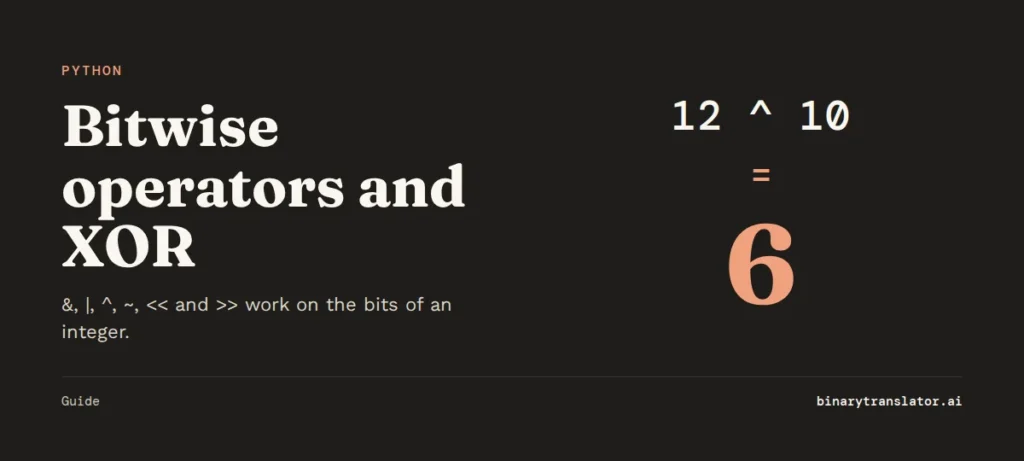 Programming
Python bitwise operators and XOR, with examples
Python's bitwise operators &, |, ^, ~, << and >> explained bit by bit. XOR for flipping bits, ciphers and logical XOR, masks and flags, shifts, and & versus and.10 min read Programming
Python struct: pack and unpack binary data
The struct module packs Python numbers into bytes and unpacks them again. Format characters, byte order, alignment, a PNG header example, records, IPv4 and the common errors.11 min read Programming
Python ord() and chr(): character to number and back
ord() returns the Unicode number of a character and chr() turns a number back into a character. Examples for ASCII, accented letters and emoji, plus the errors and how to fix them.9 min read Binary basics
Unicode, UTF-8 and ASCII explained
ASCII, Unicode and UTF-8 explained: the 128 ASCII codes, Unicode code points, how UTF-8 stores them in 1 to 4 bytes, UTF-16 compared, and what causes garbled text.8 min read Binary basics
Binary subtraction
How to subtract binary numbers: the four rules, borrowing step by step, the two's complement and one's complement methods, common mistakes and practice problems with answers.7 min read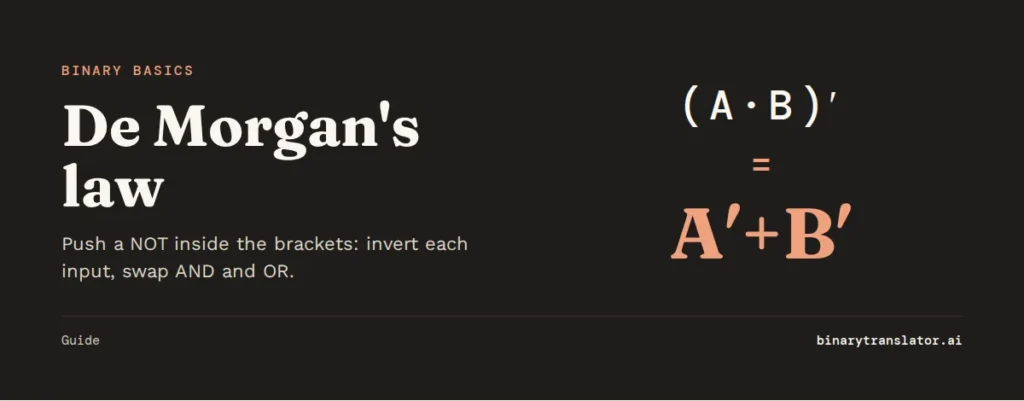 Binary basics
De Morgan's law explained
Both of De Morgan's laws with a truth table proof, a live checker, step-by-step examples, practice problems, and how the laws work in logic gates and in code.8 min read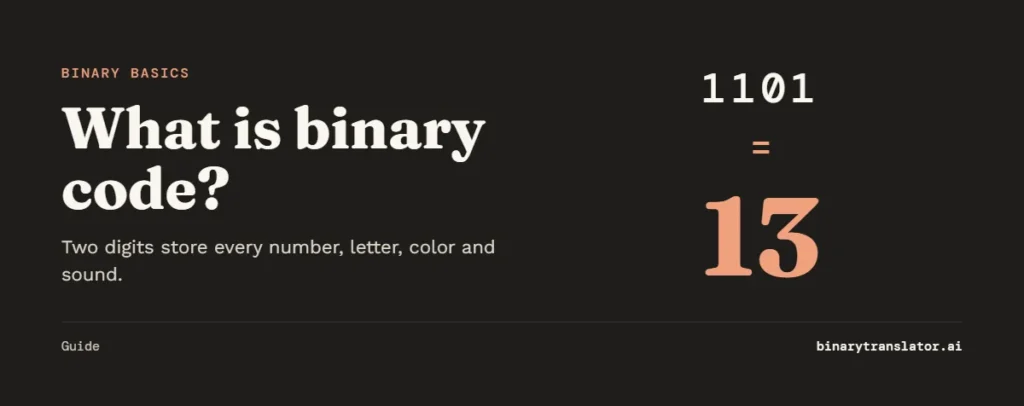 Binary basics
What is binary code?
Binary code stores numbers, text, colors, sound and programs with only 0 and 1. See how bits and bytes work, why computers chose two digits and what Hello looks like in binary.8 min read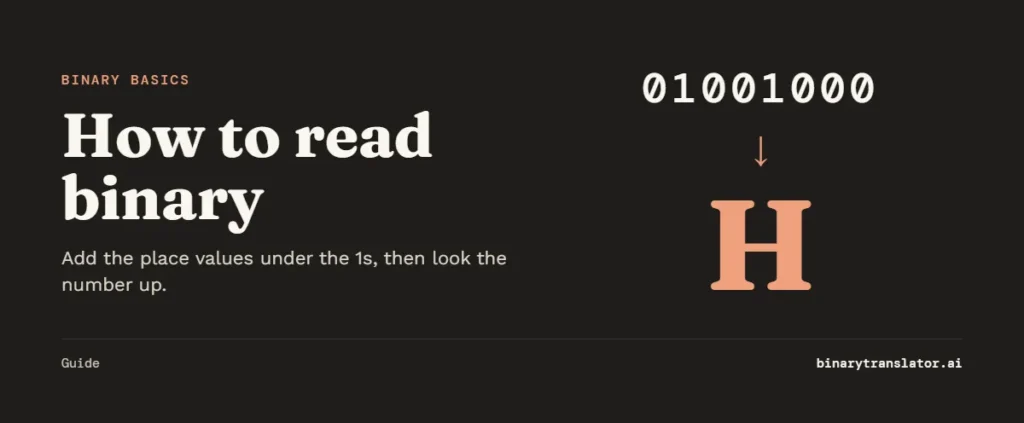 Binary basics
How to read binary
Split binary into bytes, add the place values under the 1s, then look the number up in the ASCII table. Worked examples, practice bytes and a live bit flipper.7 min readQuestions for Uma
- Where do encodings come up in your work?
- Most of my week goes into API documentation and integration guides. Encodings show up in webhook payloads sent as Base64, hashes printed in hex and requests that fail because a name has an accent the server didn't expect.
- How do you make sure a guide is correct?
- I run every example before I write about it. Each one in my guides here can be pasted into the converter on the same site to get the same answer.
- How should someone get good at reading binary?
- Learn the eight place values, 128 down to 1, then decode one byte a day by hand. One hex digit is four bits, so hex comes easily after that.